Monday, March 18, 2013

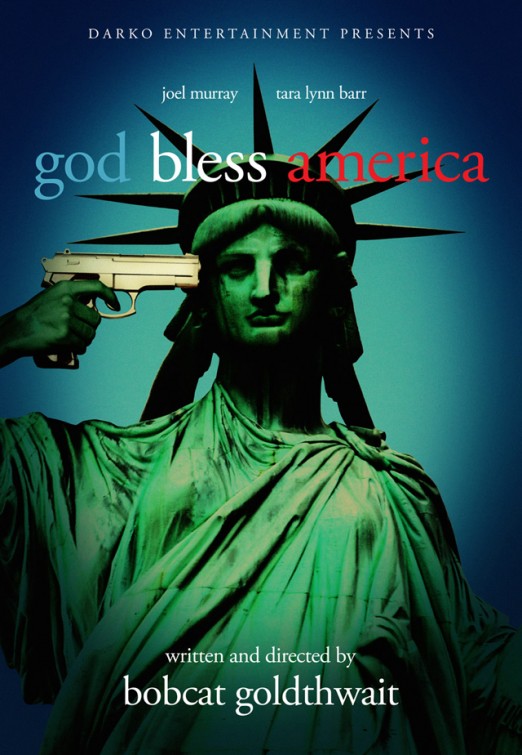
MYST #3: God Bless America


Looking for a movie to watch I googled 'most underrated movies of 2012.' After failing to find Bullhead online I settled for God Bless America. I remember thinking it looked like it would be subpar at best when I saw the trailers for it, but because the reviewer of the google site said it was good I gave it a shot. I ended up really enjoying this movie. God Bless America was outrageously violent and had a surplus of satire, but it worked well together. I thoroughly enjoyed this movie and would give it an 8.9/10. 

In God Bless America we are introduced to Frank played by Joel Murray, (Small roles in The Artist, Larry the Cable Guy) an insomnic veteran living next door to a loud, douchey family, being disgusted by the recognizable mock reality shows he's seeing flipping through the channels. The next day Frank gets laid off work for a genuine nice offer taken poorly and goes home to receive a phone call for his ex-wife that his kid, transforming into a huge brat, no longer wishes to spend the weekend with him. With all this misery compiling at once Frank is ready to kill himself, literally gun in his mouth has an epithiney instead of killing himself, he should kill the incredible spoiled girl whiny to her dad cause he got her the wrong car on a fake Sweet Sixteen type show. After doing this a similarly minded classmate of the spoiled girl, Roxy, played by Tara Lynn Barr in her first feature film, joins Frank and the two embark a cross country killing spree of other "worthy" people. Despite this sounding like the darkest movie ever, and trust me its up there, the movie is quite funny. Despite morally knowing these two are doing wrong, you find yourself agreeing with them and in fact start to root for them. 


Overall I thought the director, known comedian Bobcat Goldthwait who also directed, (World's Greatest Dad, The Man Show) did a very good job portraying his obvious cynical views of America.  This is clearly a message movie seen in the dialogue between Frank and his co-worker and throughout the movie between Roxy and him talking about the things about America they hate.  Although some of there criticisms could get to be pretty ridiculous (giving high fives, saying literally), there were a multitude of good points showing us how awful the entertainment we are seeming to turn to more and more.  At the end of the movie you don't see Frank as a bad guy, you see him almost as a martyr to try and bring back the old America, where kids weren't as spoiled and people talked about things other than what was on television the previous night.  The fact that I had to watch Zero Dark Thirty to return my patriotism to its normal level, tells you that Goldthwait got his point across.  Overall I recommend God Bless America for both its entertainment, and its unique perspective of America.  

Sunday, March 17, 2013

MYST Post #2: Brick


As recommended by Mr. D, I decided to watch Brick after I had finished my homework one night.  I really enjoyed this movie and recommended it immediately to my friends the following day.  Shot in a film noir style, adapted to a Southern California high school seems it would be like hot sauce on oreos, a terrible combination, however Brick did it perfectly.  I was captivated the entire movie and could never predict what was going to happen next.  I gave this movie a 9.0/10, a good score for an overall good movie.


Brick starts with Brendan, a young Joseph Gordon Levitt (Premium Rush, The Dark Knight Rises, Inception) answering a phone call from a panicked ex-girlfriend mentioning terms like "Brick" and "the Pin" before hanging up.  Missing the next day Brendan uses her notebook to attempt to track her down and ends up finding her dead in a sewer pipe.  The rest of Brick is Brendan following clues and immersing himself in a high school drug ring to find his ex's killer.  I would love to write more, but as it is a mystery I would hate to spoil any part of it.

As I mentioned earlier Brick is a modern day example of a classic film noir.  Complete with a morally questionable main character, a devious femme fatale, and a world filmed with crime and violence, Rian Johnson(Looper, Brothers Bloom) directed.  What really made the movie for me would be Levitt's fast talking conversions and one-liners, another noir element, like "Throw one at me if you want, hash head. I've got all five senses and I slept last night, that puts me six up on the lot of you."  A scene that was really enjoyable to watch was when he was first introduced to the Pin.  This scene is the exelfies the character of Brendan the best, not sugar coating anything and looking to get in trouble, while at the same time looking amazingly cool and smooth.

Sunday, March 10, 2013

Poster Post: Romeo and Juliet


This is the classic Romeo and Juliet story adapted for the Great Depression.  Romeo is the son of a poor movie owner, whose dad despises the banks for not giving loans to upgrade his theatre.  Juliet is the daughter of a rich banker, whose misunderstands the poor and because of it generally dislikes them.  Romeo and Juliet meet at the theatre one time and instantly fall in love despite different wealth class and parents dislike of each other.  This story is neither pro or anti banks, but rather a why can't we work together type movie.  

The genre of the movie is a romantic-drama because the children fall in love while society, represented by their fathers, is trying to stop it. 

We decided to pic MGM as our studio.  We chose this because Romeo and Juliet is a character focused movie.  MGM during the 1930's had the biggest stars and a big name for both Romeo and Juliet makes for a financially successful movie.  

For our cast we casted Jeanette MacDonald as Juliet and Robert Montgomery as Romeo.  This choice was made since both these actors were popular, young, and attractive.  We had Victor Flemming directing it since in 1934, he directed Treasure Island so he knows how to adapt classic writings into movies.  All three actors/director are a part of the MGM family which made it easy to join this movie.  We would focus on lighting showing both the dads in darker lighting with more shadows to show a stubbornness to compromise and Romeo and Juliet in positive bright lighting to show that this is the right way.  


Obviously in a explicit story both in the violence and sexual regard the Hays Code definitely affected this adaption of Romeo and Juliet.  We choose to have zero violence to uphold the Hays Code and ended the movie with Romeo and Juliet living happily ever after opposed to the double suicide.  Also there would be no sex scenes in Romeo and Juliet, only a passionate kiss during the balcony scene and another to end the movie.  This does cripple the shock-and-awe of the Romeo and Juliet story, but the Hays Code would accept it and it has a better message.

We decided to use the technology of technicolor in an interesting manner.  The movie would be black and white up to the point of Romeo and Juliet making eye contact projecting the movie to turn into  technicolor.  We did this as an artistic expression of how the whole world changes when you meet the person you're in love with.

Monday, March 4, 2013

Formal Film Study: Wes Anderson

 Over the summer, I went last minute to Moonrise Kingdom, not knowing anything about the film, or who directed it.  I walked out of the theatre my mind was blown, Moonrise Kingdom was one of the most unique and enjoyable movies I had ever seen. Its blend of quirky humor and bizarre story almost had me clapping at the end of the movie (something I have frowned upon in the past).  At the time I planned on researching more to find out who directed/wrote it, but I had forgotten about doing this research.  Later finding out it was directed by Wes Anderson, I was curious to see more of his movies, but never ended up watching any.  When we were told we could pick a director for this formal film study, I knew I was going to choose Anderson immediately, and I really glad I did.

Over the course of two weeks I watched three Anderson films: The Royal Tennenbuams, Fantastic Mr. Fox, and Rushmore.  Similar to Moonrise Kingdom I enjoyed all three of the films giving them rankings of 8.8/10, 9.2/10 and 8.6/10 respectfully.  Besides the enjoyable peculiarity of all three of the films, the most common theme of Wes Anderson films, they were all very similar despite very different plots.

In all three movies Wes Anderson hardly uses and bright, vidid colors.  He tends to use darker tones in his movies and uses lots of dim lighting, however there is still a plethora of colors, most of them are toned back by the lighting.  An interesting color scheme I noticed in his  and each of the movies had a yellow tint to them as seen here in The Royal Tennenbuams, Fantastic Mr. Fox, and Rushmore in that order.


I noticed two particular camera shots that Wes Anderson used frequently throughout these movies.  One of these is a birds-eye view shot.  Seen when Ritchie Tennenbaum's wrists are cut amonst his recently shaven hair, to Mr. Fox grabbing the morning paper in front of his tree, Anderson definitly enjoys the birds eye view shot.  Kim Morgan a film critic was analyzing all of Wes Anderson's films before the release of Moonrise Kingdom, and writes "Anderson adores this shot with an almost fervid fetishization tantamount to Hitchcock's love of blonds." This rest of the summary can be seen here, and if truly interested in Anderson's work, Morgan does a much better job than I could have ever have written on Anderson's films.  I feel the birds eye view shot focuses the viewer onto the object in even a better way a close up of the object can since it's hardly used by other directors.  The other shot that Wes Anderson uses often is a dead center, shoulders and up shot of the characters face.  This allows viewers to focus on the character's emotions, and sometimes to add humor to the scene such as in the opossums face in Fantastic Mr. Fox.  Seen here are the latter shot:  

Of all the similarities between the three Wes Anderson films I watched the biggest one is the theme of dysfunctional relationships.  The most obvious case of this is seen in The Royal Tennenbuams, which is pretty much all about an outed father trying to come back into the lives of his grown-up child protégées, and his soon to be remarried ex-wife. While the other two movies are good examples of messed up relationships,  The Royal Tennenbuams is the pinnicale of it. One brother is jealous of the other, the one son hates his dad, brothers loving (adopted) sisters, this movie hilarity and occasaional sadness derive from the twisted relationships that is infused in the Tennenbuam family.  In the movie, Fantastic Mr. Fox, Mr. Fox and Mrs. Fox get caught stealing fowl at the beginning of the movie and promises if they escape, he will never steal again.  After ten years go by, Mr. Fox wild animal instincts take priority over the old promise and he begins to steal again.  When Mrs. Fox finds out  Mr. Fox and Mrs. Fox relationship turns shaky.  Another poor relationship seen in Fantastic Mr. Fox is Mr. Fox's son with the same aged out of town cousin.  The son has to fight for Mr. Fox's attention who has giving it all to the impressive cousin.  In Rushmore dysfunctional relationships are seen throughout the movie.  Max Fiscer, the incredibly pro-active and mature fifteen year old is in love with a first grade teacher at the same school and is constantly fighting with/for her throughout the movie.  Also Max Fiscer is embarrassed and lies about his fathers occupation of being a barber, at his prestigious boarding school.  These relationships are infused and often become the plot of Anderson's movies.  Anderson's parents divorced when Anderson was eight years old, he even said the divorce was "the most crucial event of my brothers and my growing up." (biography.com) This is evident in the stories Anderson depicts and the way he depicts them.  Like Anderson growing up to be a star director, all three of these movies ended happy and the relationship problems in the past.


Overall, I love the quirkiness of Wes Anderson's films and the humor that comes with it.  I look foward to seeing his new movie coming out this year Grand Budapest Hotel, and many more movies from him in the future (not Star Wars he turned that down).